Accuracy claim explainer
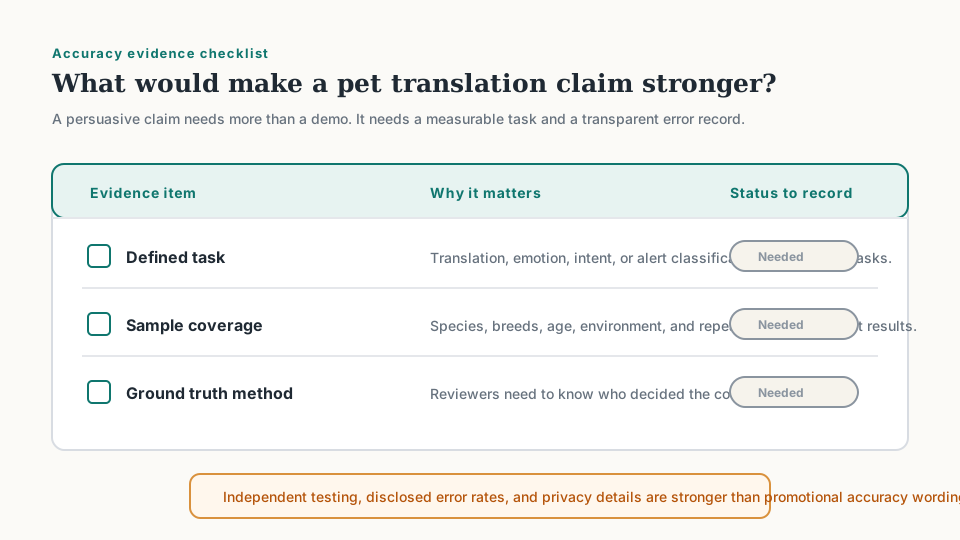
Accuracy claims around pet translation should include the task being measured, the species and breeds tested, the environment, the ground truth method, and the error rate. Without those details, a claim may be marketing language rather than scientific evidence.
“Reports a possible emotion label” is a narrower and more careful statement than “translates what your pet says.”
What AI may be able to infer
- Patterns in audio such as pitch, duration, repetition, and intensity.
- Contextual signals such as activity, timing, motion, or owner-labelled history if the app collects them.
- Broad categories such as alerting, distress-like sounds, playfulness, or repeated routines.
These categories can be useful while still falling short of literal language translation.
What has not been independently verified
Independent tests reduce the risk of cherry-picked demos. The available public record should answer whether testing was independent, whether outputs are species-specific, whether false positives are disclosed, and whether personal or pet audio is stored.
Until those details are available, the safest language is that PettiChat claims to interpret signals and that available information is still limited.
Claim Scorecard
| Claim | Source type | Evidence status | What would make it stronger |
|---|---|---|---|
| PettiChat claims to interpret pet sounds or signals. | Official / promotional source | Product wording can be recorded, but performance is not independently verified here. | Clear task definition, supported species, sample size, and disclosed error rate. |
| Claimed speed or claimed accuracy appears in promotional launch wording. | Distributed press release | Promotional, not independent verification. | Independent test protocol, raw or summarized results, and repeated samples across environments. |
| Price, reward tiers, shipping estimates, and campaign updates may appear on a campaign page. | Campaign / preorder source | Time-sensitive; must be checked live before being cited as current. | Access date, current tier details, refund language, shipping countries, and update history. |
| Public skepticism and user questions show what readers want answered. | Social / search-intent source | Useful for consumer questions, not evidence of product performance. | Independent reviews that show the test setup, outputs, failures, and limitations. |
Before backing or buying, check these points
- Seller / campaign owner clarity.
- Current price.
- Shipping countries.
- Refund policy.
- Subscription requirement.
- Continuous audio recording.
- Data storage and training use.
- Accuracy methodology.
- Independent reviews.
Translation vs emotion or intent inference
Translation implies mapping one language to another. Pet vocalizations do not work like human language in a simple word-for-word way. A more cautious description is that an AI system may infer a likely state, need, or context from signals.
That distinction matters for consumer trust. A device can still be interesting or helpful without proving that it literally translates a bark or meow into a sentence.